The range() function generates a list of numbers. This is very useful when creating new lists or when using for loops: it can be used for both.
In practice you rarely define lists yourself, you either get them from a database, the web or generate them using range().
Practice now: Test your Python skills with interactive challenges
Python range() parameters
The range() function takes parameter, which must be integers. They can be both positive and negative. By default, it creates a list of numbers starting from zero, as parameter the stop value is defined
range(stop)
But you can define the starting number of the sequence and then step size.
range(start, stop, step)
Python's range() example
Lets say you want to create a list of 100 numbers. To do that, you can use the range() function. By calling list(range(100)) it returns a list of 100 numbers. Writing them out by hand would be very time consuming, so instead use the range function:
x = list(range(100))
print(x)
Python starts counting from zero. Now what if you want to count from 1 to 100?
x = list(range(1,101))
print(x)
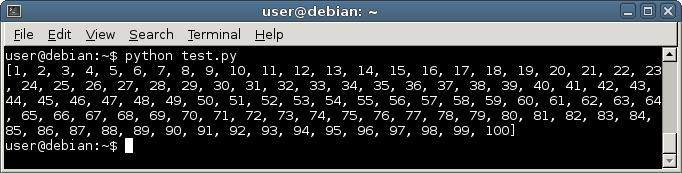
A third parameter defines the step size, by default its one. Range can be used in a for loop:
for i in range(1,11):
   print(i)
Some other examples which have a step size parameter:
>>> for i in range(0,25,5):
...     print(i)
...
0
5
10
15
20
>>> for i in range(0,100,10):
...     print(i)
...
0
10
20
30
40
50
60
70
80
90
Practice now: Test your Python skills with interactive challenges
Practice Exercises
Try the exercises below 1. Create a list of one thousand numbers 2. Get the largest and smallest number from that list 3. Create two lists, an even and odd one.