Tables can be created with the QTableWidget. It is an item-based table view, similar to what you would see in Excel.
You can include the table widget as part of your gui, or popup a window with an excel like table.
In this example (PyQt5) it'll show a window with the table, but you can make it part of your window gui with designer.
Practice now: Test your Python skills with interactive challenges
Tables
QTableWidget
The QTableWidget is a table widget with rows and columns.
The object has the methods .setRowCount(x) and .setColumnCount(y), where x is number of rows and y number of columns. You could use this as self.setRowCount(5).
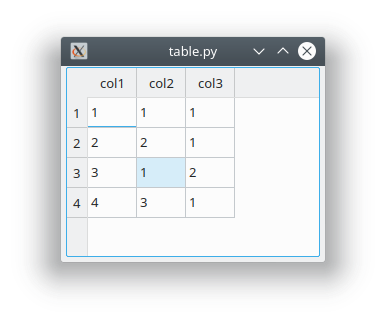
The contents is set with self.setItem(m, n, newitem), where m and n is the coordinate inside the table.
The variable newitem is of type QTableWidgetItem, which can take a text value as string. For instance: .setItem(1,2, QTableWidgetItem("Table Cell"))
Practice now: Test your Python skills with interactive challenges
Table in PyQT
The table is defined with the variable data.
data = {'col1':['1','2','3','4'],
        'col2':['1','2','1','3'],
        'col3':['1','1','2','1']}
The example below creates a table with 3 columns and a number of rows.
from PyQt5.QtWidgets import QMainWindow, QApplication, QWidget, QAction, QTableWidget,QTableWidgetItem,
from PyQt5.QtGui import QIcon
from PyQt5.QtCore import pyqtSlot
import sys

data = {'col1':['1','2','3','4'],
        'col2':['1','2','1','3'],
        'col3':['1','1','2','1']}

class TableView(QTableWidget):
    def __init__(self, data, *args):
        QTableWidget.__init__(self, *args)
        self.data = data
        self.setData()
        self.resizeColumnsToContents()
        self.resizeRowsToContents()

    def setData(self):
        horHeaders = []
        for n, key in enumerate(sorted(self.data.keys())):
            horHeaders.append(key)
            for m, item in enumerate(self.data[key]):
                newitem = QTableWidgetItem(item)
                self.setItem(m, n, newitem)
        self.setHorizontalHeaderLabels(horHeaders)

def main(args):
    app = QApplication(args)
    table = TableView(data, 4, 3)
    table.show()
    sys.exit(app.exec_())

if __name__=="__main__":
    main(sys.argv)
Practice now: Test your Python skills with interactive challenges
Practice now: Test your Python skills with interactive challenges