To group sets of code you can use functions. Functions are small parts of repeatable code. A function accepts parameters.
Without functions we only have a long list of instructions. Functions can help you organize code. Functions can also be reused, often they are included in modules.
Practice now: Test your Python skills with interactive challenges
Python Function Examples
Functions
Functions can be seen as executable code blocks. A function can be used once or more.
A simple example of a function is:
def currentYear():
    print('2018')

currentYear()
The function is immediately called in this example. Function definitions always start with the def keyword.
Functions can be reusable, once created a function can be used in multiple programs. The print function is an example of that.
Functions with parameters
In the example below we have parameter x and y. Type this program and save it as summation.py
#!/usr/bin/env python3

def f(x,y):
    return x*y

print(f(3,4))
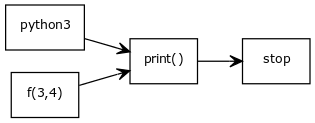
In this example we have two functions: f(x,y) and print(). The function f(x,y) passed its output to the print function using the return keyword.
Return variables
Functions can return variables. Sometimes a function makes a calculation or has some output, this can be given to the program with a return varaible.
In many cases that output is stored in a variable:
result = f(3,4)
print(result)
In this case the program will call the function f with parameters 3 and 4, then save the output to the variable result.
Practice now: Test your Python skills with interactive challenges
Practice Exercises
Try the exercises below
1. Make a function that sums the list mylist = [1,2,3,4,5] 2. Can functions be called inside a function? 3. Can a function call itself? (hint: recursion) 4. Can variables defined in a function be used in another function? (hint: scope)
After completing these continue with the next exercise.