Programs sometimes need to repeat actions. To repeat actions we can use a for loop. A for loop is written inside the code. A for loop can have 1 or more instructions.
A for loop will repeat a code block. Repeation is continued until the stop condition is met. If the stop condition is not met it will loop infintely.
These instructions (loop) is repeated until a condition is met.
Practice now: Test your Python skills with interactive challenges
Python for Loop Examples
In the exercise below we will repeat actions on every item of a list.
The first loop will repeat the print functionfor every item of the list. The second loop will do a calculation on every element of the list num and print the result.
Type the code below and run the program.
#!/usr/bin/env python3

city = ['Tokyo','New York','Toronto','Hong Kong']
print('Cities loop:')
for x in city:
    print('City: ' + x)

print('\n')  # newline

num = [1,2,3,4,5,6,7,8,9]
print('x^2 loop:')
for x in num:
    y = x * x
    print(str(x) + '*' + str(x) + '=' + str(y))
Save the file as loopexample.py Then run the code with the command:
python loopexample.py
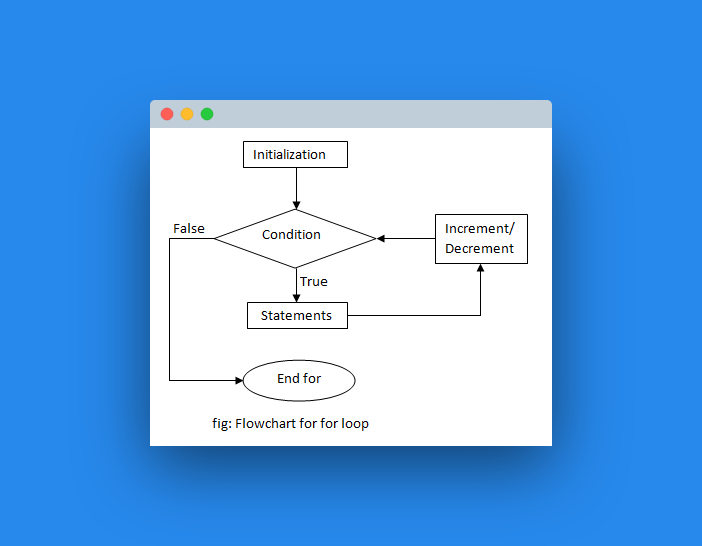
Schematically a for loop does this:
Practice now: Test your Python skills with interactive challenges
Practice Exercises
Try the exercise below:
1. Make a program that lists the countries in the set
clist = ['Canada','USA','Mexico','Australia']
2. Create a loop that counts from 0 to 100 3. Make a multiplication table using a loop 4. Output the numbers 1 to 10 backwards using a loop 5. Create a loop that counts all even numbers to 10 6. Create a loop that sums the numbers from 100 to 200